
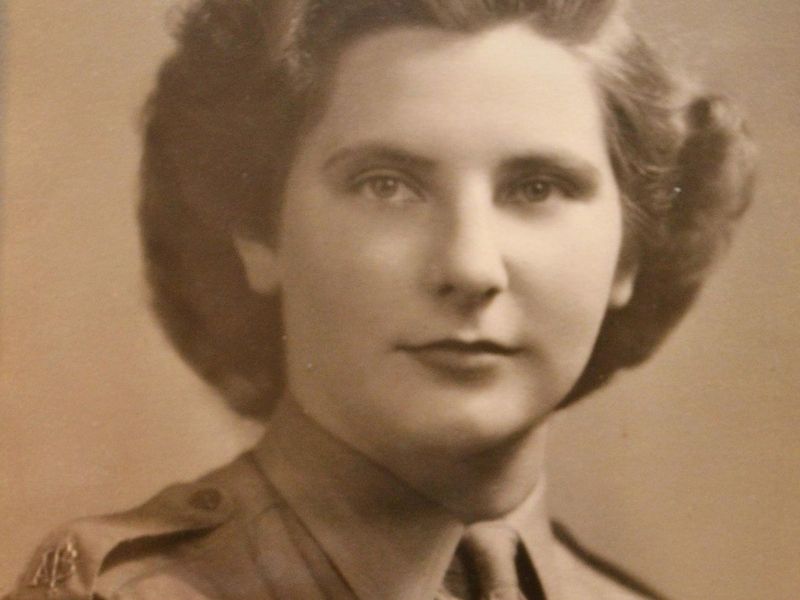
“I wanted to do something more for the war effort than bake sausage rolls.”
S/Sgt Charlotte Elizabeth “Betty” Vine-Stevens (Webb), Washington DC, May 1945, Bletchley Park
Betty Webb (1923–2025) was a remarkable Second World War code breaker whose intelligence work at Bletchley Park and later the Pentagon helped shape the Allied war effort.
Arriving at Bletchley aged just 18, she worked in the secretive Hut 3 and other sections, helping to process German police communications that revealed early evidence of the Holocaust, and later paraphrasing decoded Japanese military messages for American commanders. Like many of her colleagues, she had no idea at the time of the global significance of her work, handling streams of encrypted letters and figures without knowing the outcomes they influenced.
After wartime secrecy lifted in 1975, Webb became a passionate public educator, giving talks, writing about her experiences, and tirelessly promoting the legacy of Bletchley Park. Her lifelong dedication to service was recognised with an MBE (2015) and the French Légion d’honneur (2021). Remembered as a warm, determined advocate for women veterans, Webb helped ensure that the hidden contribution of thousands of women at Bletchley would never again be overlooked.
Teaching Themes
Women in intelligence: Highlight the vital but often hidden roles women played in wartime codebreaking.
Secrecy in wartime: Explore how strict confidentiality shaped Webb’s work and life for decades.
Everyday people in major events: Show how ordinary young women contributed to world-changing intelligence efforts.
Holocaust intelligence: Introduce how intercepted communications revealed early evidence of Nazi atrocities.
Technology and codebreaking: Examine how communication, decoding, and message paraphrasing supported Allied strategy.
Legacy and remembrance: Consider Webb’s later work sharing Bletchley Park’s story and preserving public memory.
Period & Place
National Curriculum Link
Challenges for Britain, Europe and the wider world 1901 to the present day
Exam Specification Links
GCSE Edexcel 12: Warfare and British society, c.1250–present
GCSE OCR A J410/10 War and British Society c.790 to c.2010.
A Level Edexcel 37.1: The changing nature of warfare, 1859–1991
Sources
Bletchley Park has collated a collection of interviews with the men and women who worked as Code Breakers during the Second World War as part of an Oral Histories Project. Webb’s interview provides unique insight into her experiences. Bletchley Park now operates as a museum and learning centre, providing further opportunity to explore source materials. https://www.bletchleypark.org.uk/wp-content/uploads/record_attachments/2416.pdf
Scholarship
McDowell, P. (1998). The Women of Grub Street: Press, Politics, and Gender in the London Literary Marketplace 1678-1730. Oxford: Clarendon Press.
Webb, B. (2023). No More Secrets: My Part in Codebreaking at Bletchley Park and the Pentagon. Gemini Books Group.
Jill Liddington (1998) Female Fortune: Land, Gender and Authority. Rivers Oram Press.
Helena Whitbread (2010) The Secret Diaries of Miss Anne Lister. Virago. (An updated version of 1988, I Know My Own Heart).