
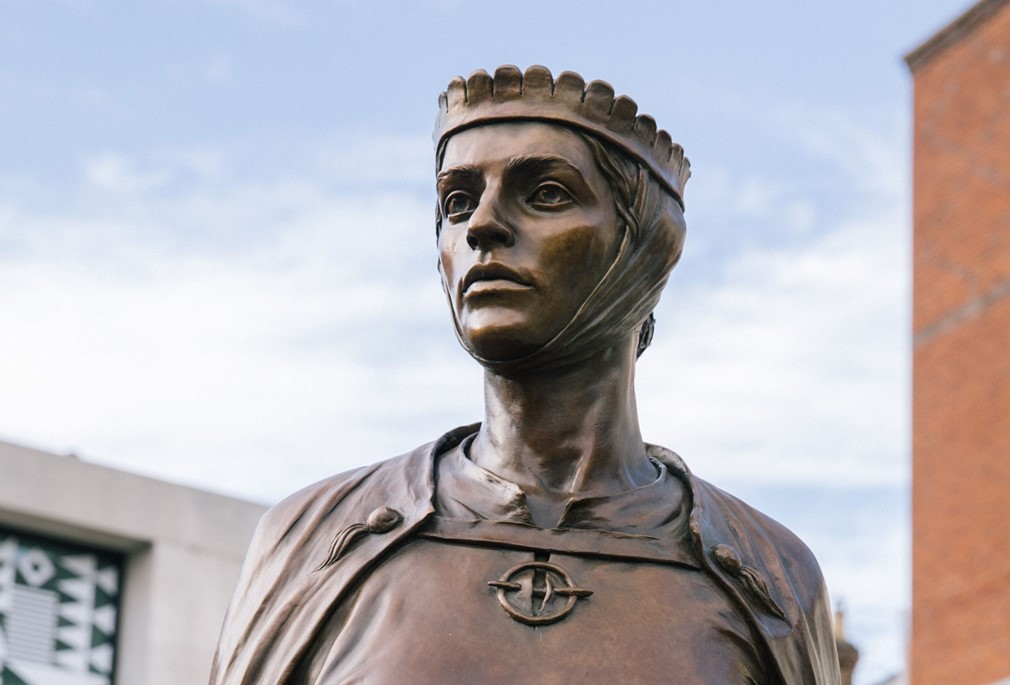
“Courageous, strong minded and strong willed, she was an astute and able businesswoman, a powerful matriarch and a leading member of Winchester Jewry.”
From Licoricia of Winchester by Rebecca Abrams (2022).
Licoricia of Winchester (c. 1220-1277) first appears in records in 1234 as a young widow with three sons and one daughter. She was a Jewish businesswoman who lent money to royalty and others.
In 1244 her second husband died and Licoricia was kept in the Tower of London by King Henry III until she paid 5,000 marks (approximately £2.5 million today) to inherit her husband’s estate, as well as another £2,500 towards a shrine to Edward the Confessor.
Many Medieval figures depended on her to lend them money, including the Queen, Eleanor of Provence, and the Earl of Leicester, Simon De Montfort.
Her son Benedict became the only Jewish member of a guild in Medieval England.
She was murdered alongside her Christian servant, Alice of Bickton in 1277. This is likely to be due to Antisemitism, as by 1290 all Jews were expelled from England by King Edward I.
In 2018 the city of Winchester was granted permission for a statue of Licoricia, which was finally unveiled in 2022. On it is inscribed ‘Love thy neighbour as thyself’, from the book of Leviticus, which appears in the Torah and the Bible.
Teaching Themes
Women’s roles: Wealthiest woman in Medieval England – shows that women were not always economically second-class.
Gender, religion and power: She was a shrewd business woman in her own right; her husband divorced his previous wife to marry her.
Antisemitism: A success story but within the context of Antisemitic attitudes shortly before the Edict of Expulsion.
Public history: Useful as part of a wider debate of who we commemorate through statues and public memorials.
Using historical sources: Much of our knowledge of her comes from legal and financial sources – students could use these to examine her story.
Period & Place
National Curriculum Link
The development of Church, state and society in Medieval Britain 1066-1509
Society, economy and culture: for example, trade and towns.
Exam Specification Links
OCR GCSE History Around Us local study opportunity.
OCR A-level History A: England 1199-1272.
Sources
The Licoricia of Winchester website has information about her life and also the campaign for the statue as well as lesson resources for Primary and Secondary schools: https://licoricia.org/
Pearson has an information pack with some primary sources: https://www.pearson.com/content/dam/global-store/en-gb/schools/BIG-11838-D0261c-HTOTM-April-Licoricia-worksheet-PRF3.pdf
Medieval Anglo-Jewish Women website has links to all legal sources: https://majw.uvic.ca/lico1.html
Scholarship
Abrams, R. (2022). Licoricia of Winchester: Power and Prejudice in Medieval England. Winchester: The Licoricia of Winchester Appeal.
Bartlet, S. (2000) Three Jewish Business Women in Thirteenth-Century Winchester. Jewish Culture and History 3(2): 31–54.
Bartlet, S. (2015) Licoricia of Winchester: Marriage, Motherhood, and Murder in the Medieval Anglo-Jewish Community. Vallentine Mitchell.
Butler, S. (2023) Who Killed Licoricia of Winchester? A Medieval Murder Mystery. Legal History Miscellany. n.d. https://legalhistorymiscellany.com/2023/02/10/who-killed-licoricia-of-winchester-a-medieval-murder-mystery/