
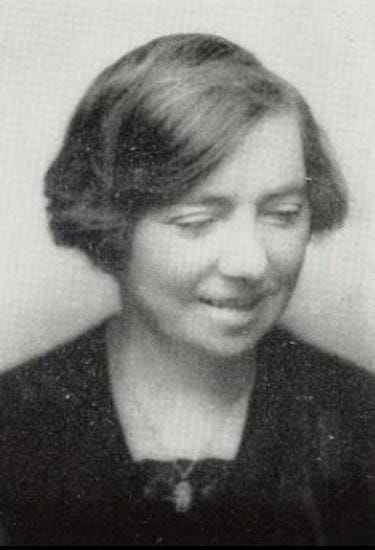
‘The wolf-dog stood at bay once more/And heard unmoved the Lion’s roar… Today we stand in freedom’s hall/And freely make our sacrifice.’
Extract from Cavanaugh’s ‘Eastertide 1916’ poem
Maeve Cavanagh (1878-1960) was a political activist and poet. She was a member and secretary of Cumman na mBán, the Gaelic League, and one of the few women in James Connolly’s Irish Citizen Army.
As the First World War broke out, Cavanagh’s poems focused on the horrors of warfare, to dissuade Irish men from joining the British Army. She was involved in the revolutionary activities at Liberty Hall, with her poems being published in the newspapers there, such as the Worker’s Republic.
Cavanagh was an eye-witness to the Easter Rising in 1916 where her brother Ernest was shot dead. Connolly, who led the Easter Rising, called Cavanagh the ‘poetess of the revolution’.
Cavanagh was the only woman on the Irish Citizen Army Comrade Veterans team which edited the official History of the Irish Citizen Army, by R.M. Fox, in 1943. She continued to advocate for Irish independence in the ensuing struggles with Britain after the Irish Free State was granted in 1922.
Teaching Themes
Decolonisation: the struggle for Irish independence against British rule, in the wider context against dominion status for Canada, Australia and New Zealand in the late 19th century.
Female revolutionaries: Cavanagh was involved in the Irish independence movement as a member of the Irish Citizen Army and Gaelic League.
Art and activism: Cavanagh’s poems became important rallying cries of the Irish Home Rule movement.
First World War: The campaigns Cavanagh involved herself in were ongoing at the time of the war and questioned the legitimacy of the British Army in Ireland.
Social history: the roles Cavanagh held in the cultural and educational activities in Liberty Hall, as well as local protests such as the Dublin lockout and soup kitchen, show the activities of women in early 20th century Dublin.
Period & Place
National Curriculum Link
Ireland and Home Rule
Exam Specification Links
A level OCR Paper 3 Britain and Ireland 1791-1921
Edexcel Paper 3 Ireland and the Union c.1774-1923
Sources
Cavanagh’s papers are held in the National Library of Ireland. Many of Cavanagh’s poems are available to view online (such as in the collection, ‘A Voice of Insurgency’), many of which contain eye-witness accounts of the Easter Rising in 1916 https://archive.org/details/voiceofinsurgenc00cava/mode/2up?ref=ol
The official History of the Irish Citizen Army, by R.M. Fox was edited by Cavanagh and is one of the few surviving accounts from former members of the group.
Documents relating to Irish Home Rule and British government responses to the Easter Rising can be found on the National Archives and Hansard websites.
Scholarship
McDiarmid, L. 2016 At Home in the Revolution: what women said and did in 1916. Dublin: Royal Irish Academy.
Charles Townshend trilogy of books on Irish independence: The Partition, Easter 1916 and The Republic.
McKitterick, D., McVea, D. 2012 Making Sense of the Troubles. London: Penguin.
Kelly, M. ‘Home Rule for Ireland: For and Against’, The Historian, Winter (2014-15)
Foy, M., Barton, B. 2011 The Easter Rising. Cheltenham: The History Press.
McNally, M., Dennis, P. 2007 Easter Rising: Birth of the Irish Republic. Oxford: Osprey.
McConnel J. BBC History website https://www.bbc.co.uk/history/british/victorians/home_rule_movement_01.shtml