
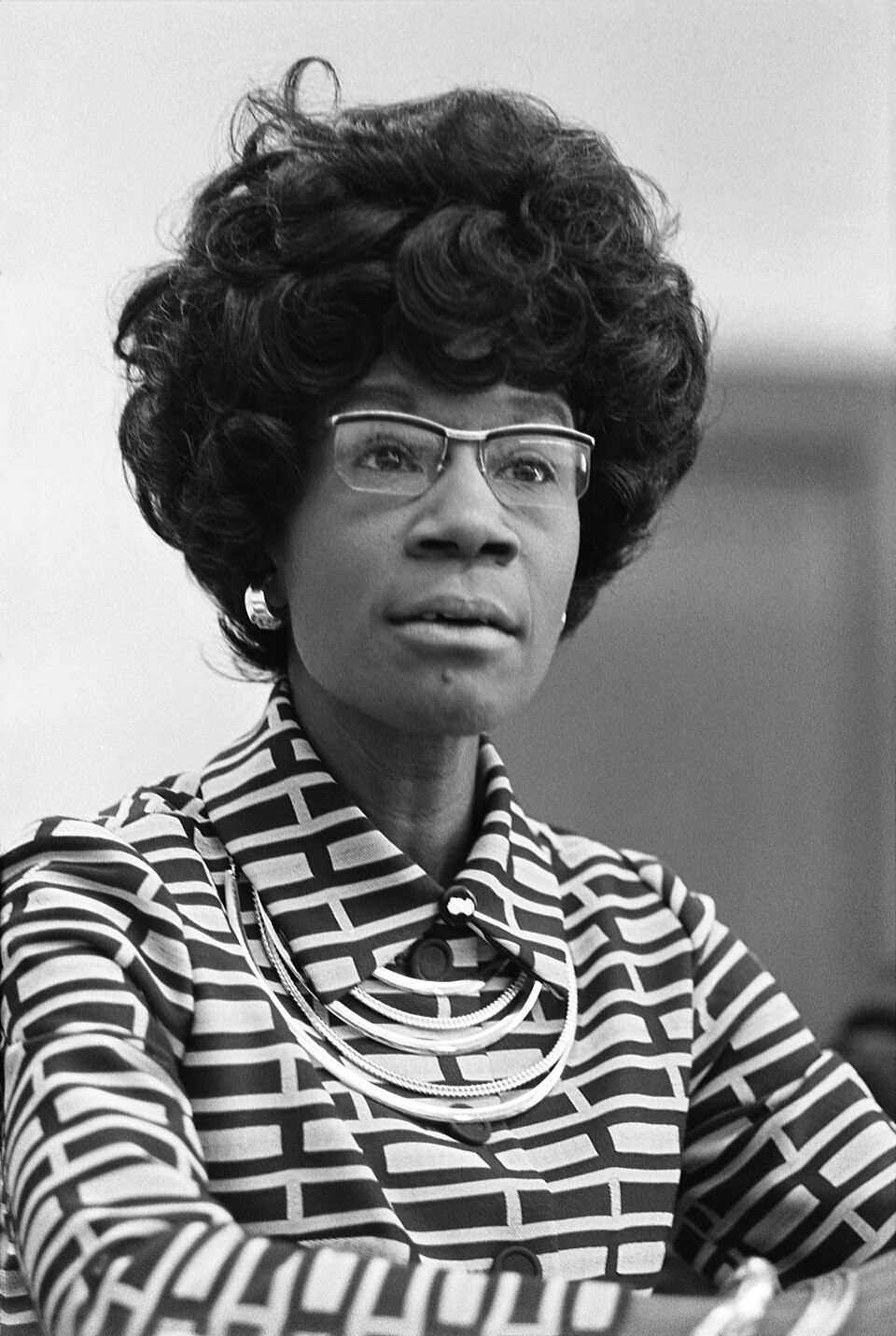
“If they don’t give you a seat at the table, bring a folding chair.”
Advice given by Shirley Chisholm to her friend Donna Brazile.
Shirley Chisholm (1924–2005) was a teacher, political reformer and civil rights campaigner who became the first Black woman elected to the United States Congress (in 1968).
Representing Brooklyn, New York, she built her reputation on outspoken advocacy for racial equality, women’s rights, social welfare and education, challenging party leaders as well as political convention.
In 1972, she ran for the Democratic Party’s presidential nomination, becoming the first Black candidate to seek the nomination of a major party and the first woman to campaign seriously for it.
Chisholm’s slogan, “Unbought and Unbossed,” captured her independence and refusal to be controlled by party machines or donors.
Throughout her career, she used her platform to widen participation in democracy and to argue that representation only matters if it is matched by real, practical change for ordinary people.
Teaching Themes
Civil rights and political representation: Chisholm’s election and congressional career show how protest movements translated into political power — and the barriers that still remained.
Women in politics: Her career highlights the limits placed on women candidates, the role of the media, and the strategies used to build credibility and coalitions.
Intersectionality in practice: Chisholm’s campaigning connected racism, sexism and poverty — showing how different inequalities overlap in lived experience.
Democracy and participation: Her “unbossed” politics is a case study in party machines, voter engagement, grassroots organising and political independence.
Social history and welfare: Chisholm’s focus on education, childcare and social programmes links political change to everyday life for families and communities.
Period & Place
National Curriculum Link
At least one study of a significant society or issue in world history and its interconnections with other world developments.
Exam Specification Links
Edexcel A Level – 39.1: Civil rights and race relations in the USA, 1850–2009
OCR A Level – Civil Rights in the USA 1865–1992
Sources
Chisholm’s speeches, campaign material and congressional work can be accessed through US National Archives and Library of Congress.
Her autobiography Unbought and Unbossed is an accessible starting point, capturing her political goals, campaign experiences and critique of party power.
Records connected to Congress (debates, voting, committees) and to the 1972 campaign provide strong material for enquiries into representation, political change and the realities of reform.
Scholarship
Curwood, A.C. (2023) Shirley Chisholm: Champion of Black Feminist Power Politics. Chapel Hill: University of North Carolina Press.
Fraser, Z. A. (Ed) (2024) Shirley Chisholm In Her Own Words: Speeches and Writings. University of California Press.
Munthali, M. (2018) Pushing the Glass Ceiling: Shirley Chisholm & the Democratic Party. Women Leading Change: Case Studies on Women, Gender, and Feminism 3(2): https://journals.tulane.edu/ncs/article/view/1334
Wierda, M. (2025) To be counted is to be considered. The Panorama https://thepanorama.shear.org/2026/01/06/to-be-counted/
Winslow, B. (2013) Shirley Chisholm: Catalyst for Change. New York: Routledge.